Hong Kong Face Painting Pricing | History, Principles, Tools Full Guide
IQA Level 3 Painting Course (Progressive) Fees | Sham Shui Po Children's Body Painting Classes
Hong Kong Party & Birthday Face Painting Services | IQA International Certification Courses
IQA professional face painting course. It comprehensively explains the history of face and body painting, professional colour principles, full toolkits, practical techniques, creative inspiration, and aftercare methods. It also updates the latest tuition fees and enrolment rules for the IQA Level 3 face painting course. This series is a progressive professional programme with a step‑by‑step system: you must complete and pass the previous level before advancing to the next. Whether you are looking to book face painting services for a Hong Kong birthday party, Halloween event, school fair, or shopping mall family carnival, or you wish to systematically learn painting techniques, obtain an IQA international certificate, and become a professional painter, this guide provides comprehensive reference. Face painting has become one of the most popular attractions at family events, commercial activities and themed parties in Hong Kong.
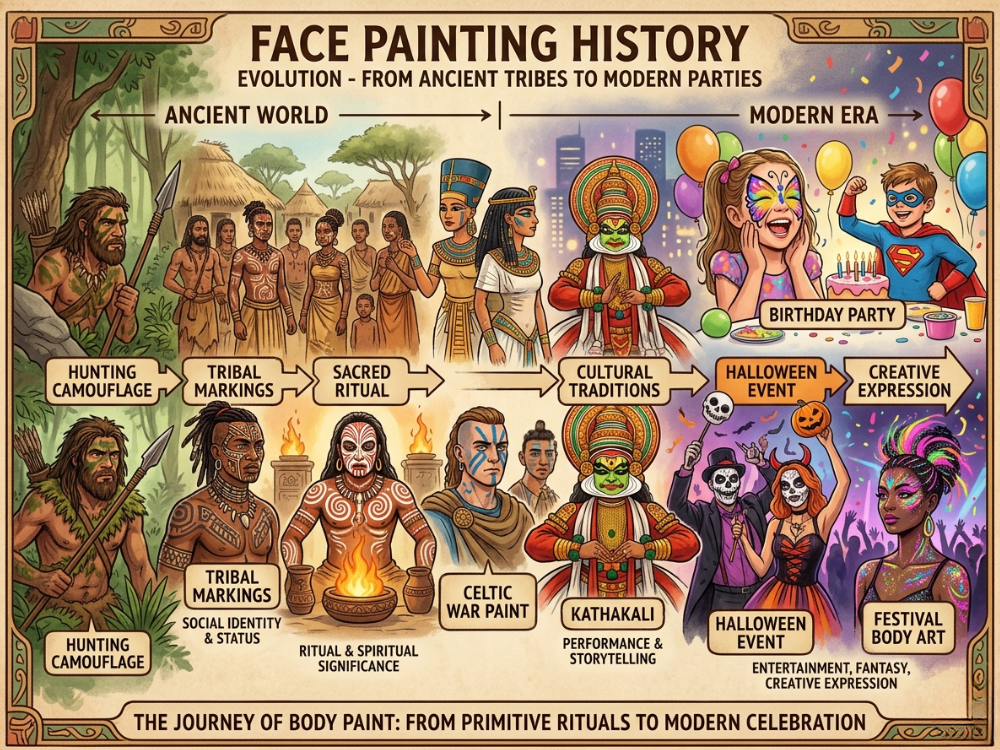
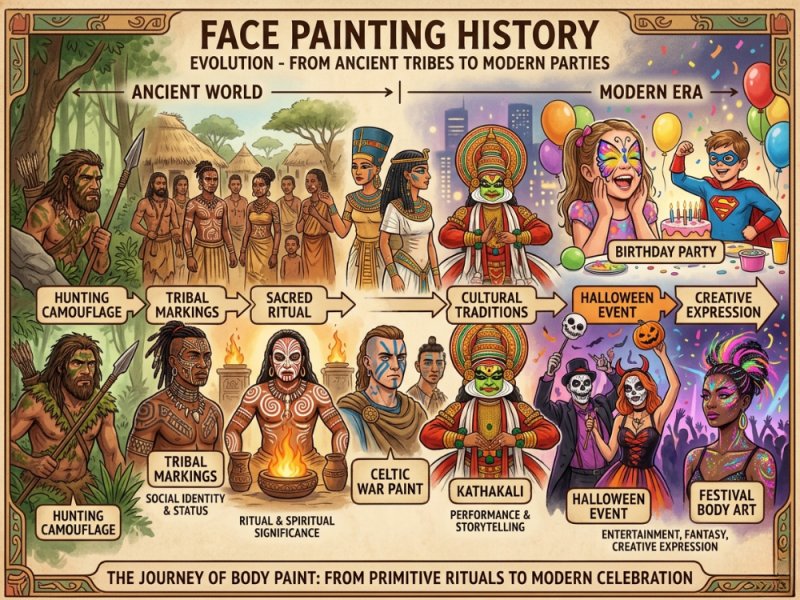
From ancient tribes to modern parties – illustrating the thousand‑year evolution of body painting, including ancient uses (hunting camouflage, tribal identification, rituals) and modern entertainment applications (birthday parties, Halloween events).
1. History of Body Painting | Ancient Uses vs Modern Applications
Face and body painting have a long history – one of humanity's oldest art forms, with ancient and modern uses having changed dramatically over time.
Ancient Uses of Body Painting
In ancient times, people used natural minerals and plant extracts to paint on skin. Painting was not for entertainment but revolved around survival, tribal identity, and rituals:
Hunting camouflage: using natural colours to blend into the environment and increase hunting success.
Tribal identification: using different colours and patterns to distinguish members, achievements, and religious beliefs.
Skin protection: using natural materials to block UV rays and repel insects.
Ceremonial rites: ancient civilisations in Egypt and the East used body painting in sacrifices and prayers as exclusive ritual makeup.
Chinese opera masks and traditional European festival makeup are classic art forms that continue the legacy of ancient body painting.
Hunting camouflage: using natural colours to blend into the environment and increase hunting success.
Tribal identification: using different colours and patterns to distinguish members, achievements, and religious beliefs.
Skin protection: using natural materials to block UV rays and repel insects.
Ceremonial rites: ancient civilisations in Egypt and the East used body painting in sacrifices and prayers as exclusive ritual makeup.
Chinese opera masks and traditional European festival makeup are classic art forms that continue the legacy of ancient body painting.
Modern Uses of Face & Body Painting
Modern painting has abandoned coarse raw materials, adopting EU‑certified water‑based safe pigments. Its focus has shifted to three areas: entertainment art, commercial services, and professional skills.
Event scenes: children's birthday parties, Halloween celebrations, school fairs, shopping mall family carnivals.
Art applications: wedding interactive segments, stage styling, photography, professional body art displays.
Career development: interest training, professional skill teaching; after completing the course, students can obtain IQA international certificates and work as on‑site painters or event painting service providers.
The core difference: ancient painting centred on survival, faith, and tribal distinction; modern Hong Kong face painting focuses on parent‑child interaction, artistic creation, and commercial services.
Event scenes: children's birthday parties, Halloween celebrations, school fairs, shopping mall family carnivals.
Art applications: wedding interactive segments, stage styling, photography, professional body art displays.
Career development: interest training, professional skill teaching; after completing the course, students can obtain IQA international certificates and work as on‑site painters or event painting service providers.
The core difference: ancient painting centred on survival, faith, and tribal distinction; modern Hong Kong face painting focuses on parent‑child interaction, artistic creation, and commercial services.
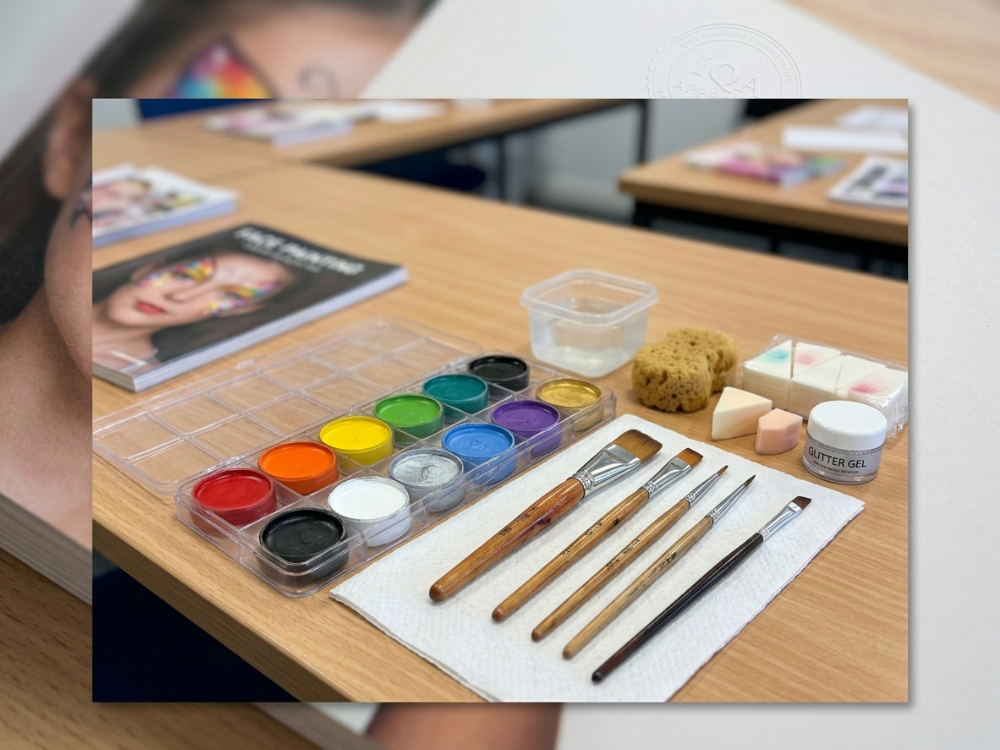
Professional face painting tools and pigments – water‑based cream paints, brushes (flat, round, angled), sponges, palette – standard IQA course equipment.
2. Face Painting Colour Principles
The pigments used in professional party painting and teaching courses follow rigorous technical standards, which are a key focus in IQA courses:
Material properties: water‑based cream pigments with moisturising ingredients (glycerin, aloe vera) and food‑grade colourants. No heavy metals or irritating preservatives – gentle on skin, suitable for Hong Kong children and adults.
Adhesion principle: pigments adhere evenly to the superficial stratum corneum, forming a breathable film without clogging pores, placing minimal burden on the skin.
Colour application: based on the three primary colours (red, yellow, blue), dozens of derived colours can be mixed freely, combined with professional blending techniques to create three‑dimensional patterns – a key practical component of the course.
Material properties: water‑based cream pigments with moisturising ingredients (glycerin, aloe vera) and food‑grade colourants. No heavy metals or irritating preservatives – gentle on skin, suitable for Hong Kong children and adults.
Adhesion principle: pigments adhere evenly to the superficial stratum corneum, forming a breathable film without clogging pores, placing minimal burden on the skin.
Colour application: based on the three primary colours (red, yellow, blue), dozens of derived colours can be mixed freely, combined with professional blending techniques to create three‑dimensional patterns – a key practical component of the course.
3. Suitable and Unsuitable Groups for Face Painting | Strict Hygiene Standards
Based on classroom safety rules and on‑site service requirements, we clearly define suitable and unsuitable groups to avoid skin damage or allergies:
Suitable: children aged 3 and above, adults of all ages; people with mildly dry skin can normally enjoy face painting after a basic skin test.
Not suitable: people with open wounds, eczema, skin inflammation, or stubborn sensitive skin; infants aged 2 or below, as their stratum corneum is too thin and may be easily irritated by pigments.
Additional note: whether for painting services or classroom practice, we always perform a localised skin test beforehand to ensure safety.
Suitable: children aged 3 and above, adults of all ages; people with mildly dry skin can normally enjoy face painting after a basic skin test.
Not suitable: people with open wounds, eczema, skin inflammation, or stubborn sensitive skin; infants aged 2 or below, as their stratum corneum is too thin and may be easily irritated by pigments.
Additional note: whether for painting services or classroom practice, we always perform a localised skin test beforehand to ensure safety.
4. Professional Face Painting Tools
LBEDU IQA painting courses provide students with a full set of professional tools – essential equipment for Hong Kong professional painters:
Pigments: water‑based cream paints, including regular colours, fluorescent colours, etc.
Brushes: flat brushes (large area base colour), round brushes (fine lines and details), angled brushes (blending, contouring).
Auxiliary tools: professional sponges, skin barrier cream, setting spray, disinfectants, makeup remover wipes, palette.
Pigments: water‑based cream paints, including regular colours, fluorescent colours, etc.
Brushes: flat brushes (large area base colour), round brushes (fine lines and details), angled brushes (blending, contouring).
Auxiliary tools: professional sponges, skin barrier cream, setting spray, disinfectants, makeup remover wipes, palette.
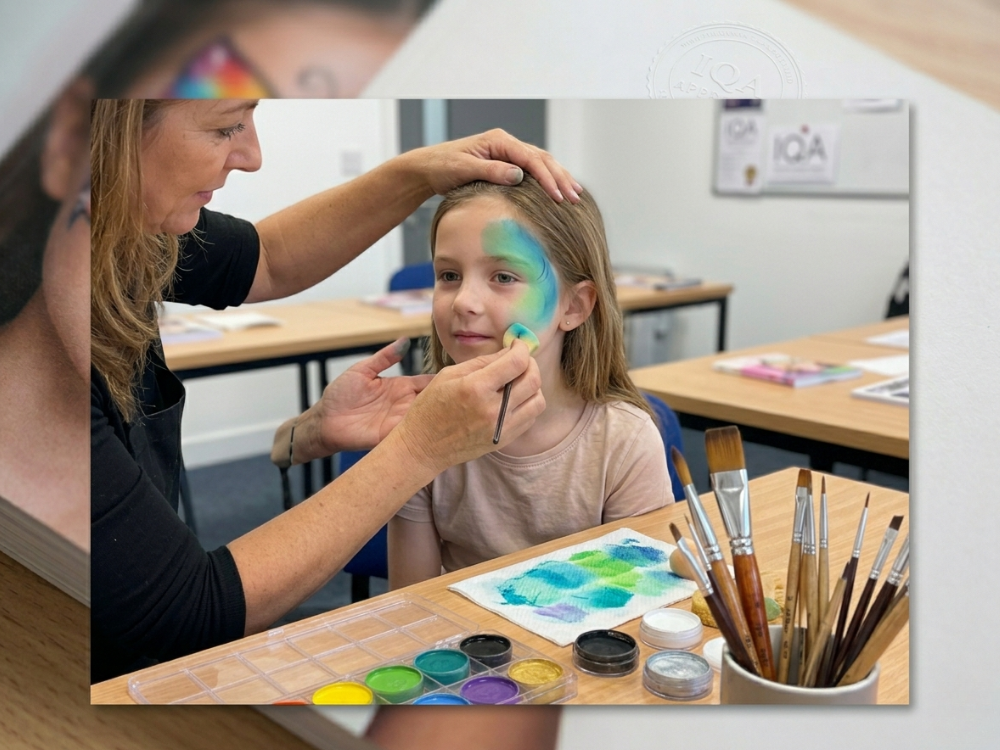
Instructor demonstrating the standard sequence – base colour first, then outlines, including sponge application, fine line outlining and colour blending techniques.
5. Practical Face Painting Techniques
All techniques follow IQA teaching standards, suitable for beginners and commercial events:
Thoroughly clean the skin before painting and apply a thin layer of barrier cream – this reduces pigment adhesion and protects the skin.
Follow the sequence of "base colour first, then outlines". Wait for the base colour to dry completely before painting details to avoid smudging.
Take only a small amount of pigment on the brush and layer colours gradually for even, three‑dimensional results.
Around the eyes and mouth (areas with frequent movement), apply setting spray at the end to prevent colour from rubbing off.
Thoroughly clean the skin before painting and apply a thin layer of barrier cream – this reduces pigment adhesion and protects the skin.
Follow the sequence of "base colour first, then outlines". Wait for the base colour to dry completely before painting details to avoid smudging.
Take only a small amount of pigment on the brush and layer colours gradually for even, three‑dimensional results.
Around the eyes and mouth (areas with frequent movement), apply setting spray at the end to prevent colour from rubbing off.
6. Painting Inspiration Sources | Aligned with IQA Level 1-3 Progressive Design
Inspiration for everyday creation and classroom teaching falls into four categories, matching the gradient teaching of IQA's Level 1-3 face painting courses:
Natural elements: flowers, rainbows, clouds (Level 1 – basic beginner designs).
Anime/animal IP: unicorns, tigers, Spider‑Man, princesses (Level 2 – popular party designs).
Festive themes: Halloween skulls, Christmas patterns, carnival 3D designs (Level 3 – advanced complex designs).
Custom originals: designs tailored to individual preferences and event themes.
Natural elements: flowers, rainbows, clouds (Level 1 – basic beginner designs).
Anime/animal IP: unicorns, tigers, Spider‑Man, princesses (Level 2 – popular party designs).
Festive themes: Halloween skulls, Christmas patterns, carnival 3D designs (Level 3 – advanced complex designs).
Custom originals: designs tailored to individual preferences and event themes.
7. Standard Face Painting Operation Process
Fully following IQA standard procedures, applicable to all types of events in Hong Kong:
Communicate with the client – understand skin condition and preferred design, perform a wrist patch test.
Clean the face of oil and dirt.
Apply barrier cream evenly.
Sponge large areas → fine brush for outlines → detail colouring and blending.
Spray setting spray to lock the colours.
Explain aftercare methods and proper removal steps.
Communicate with the client – understand skin condition and preferred design, perform a wrist patch test.
Clean the face of oil and dirt.
Apply barrier cream evenly.
Sponge large areas → fine brush for outlines → detail colouring and blending.
Spray setting spray to lock the colours.
Explain aftercare methods and proper removal steps.
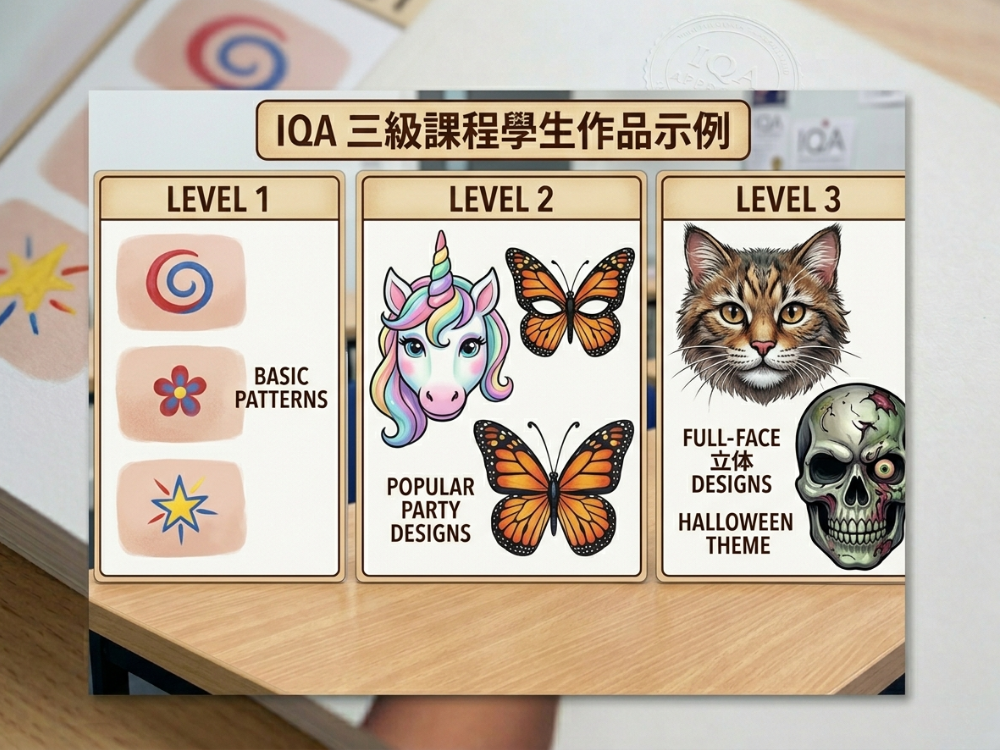
Showing Level 1 basic patterns, Level 2 popular party designs (unicorn, butterfly), Level 3 full‑face 3D designs (animals, Halloween themes).
8. Aftercare Tips to Extend the Longevity of Face Painting
To make face painting last longer, follow these tips:
Avoid rubbing the face vigorously or heavy sweating for long periods.
Avoid greasy foods – oils dissolve water‑based pigments and cause fading.
Before outdoor activities or high‑temperature places, reapply setting spray to strengthen fixation.
Remove on the same evening using baby cleansing products and warm water – no pigment residue.
Avoid rubbing the face vigorously or heavy sweating for long periods.
Avoid greasy foods – oils dissolve water‑based pigments and cause fading.
Before outdoor activities or high‑temperature places, reapply setting spray to strengthen fixation.
Remove on the same evening using baby cleansing products and warm water – no pigment residue.
9. Hong Kong Party Face Painting Pricing Overview
Based on Hong Kong market rates and our institution's service standards, the following prices apply to birthday parties, schools, shopping malls, and estate events:
| Duration | Number of People | Market Reference Price | Our Price | Applicable Scenarios |
|---|---|---|---|---|
| 1 hour | 6-8 persons | HK$1300+ | HK$1300 | Small family birthday parties, small estate events |
| 2 hours | 12-16 persons | HK$1780+ | HK$1780 | Regular children's birthday parties |
| 3 hours | approx. 20 persons | HK$2400+ | HK$2500 | School fairs, large shopping mall family carnivals |
Additional note: can be combined with magic shows, bouncy castles, on‑site photography etc. for package discounts; travel expenses are extra for remote locations.
10. IQA Level 3 Face Painting Course | Latest Fees + Progressive Enrolment Rules
Core Enrolment Rules
This IQA face painting series is a progressive system designed for Hong Kong students. Requirements:
To enrol in Level 2 (advanced), you must first complete and pass Level 1 (introductory).
To enrol in Level 3 (advanced), you must complete Level 1 + Level 2.
After successfully completing each level, you can obtain the corresponding IQA international certificate.
To enrol in Level 2 (advanced), you must first complete and pass Level 1 (introductory).
To enrol in Level 3 (advanced), you must complete Level 1 + Level 2.
After successfully completing each level, you can obtain the corresponding IQA international certificate.
Course Levels, Hours and Latest Tuition Fees
Level 1 Introductory Course | Duration 2 hours | HK$580
Suitable for complete beginners. Teaching content: basic stars, flowers, line patterns, pigment safety knowledge – ideal for hobbyists.
Level 2 Advanced Course | Duration 3 hours | HK$780
Teaching content: butterflies, unicorns, tiger stripes and other popular party designs, hand painting – suitable for those wanting to work as part‑time painters.
Level 3 Advanced Course | Duration 4 hours | HK$980
Teaching content: full‑face 3D animal designs, complex Halloween and festive themes, professional techniques for commercial events.
Venue: Winsun Building, Sham Shui Po, Kowloon
Enquiry / Registration WhatsApp: +852 9548 8600
Suitable for complete beginners. Teaching content: basic stars, flowers, line patterns, pigment safety knowledge – ideal for hobbyists.
Level 2 Advanced Course | Duration 3 hours | HK$780
Teaching content: butterflies, unicorns, tiger stripes and other popular party designs, hand painting – suitable for those wanting to work as part‑time painters.
Level 3 Advanced Course | Duration 4 hours | HK$980
Teaching content: full‑face 3D animal designs, complex Halloween and festive themes, professional techniques for commercial events.
Venue: Winsun Building, Sham Shui Po, Kowloon
Enquiry / Registration WhatsApp: +852 9548 8600
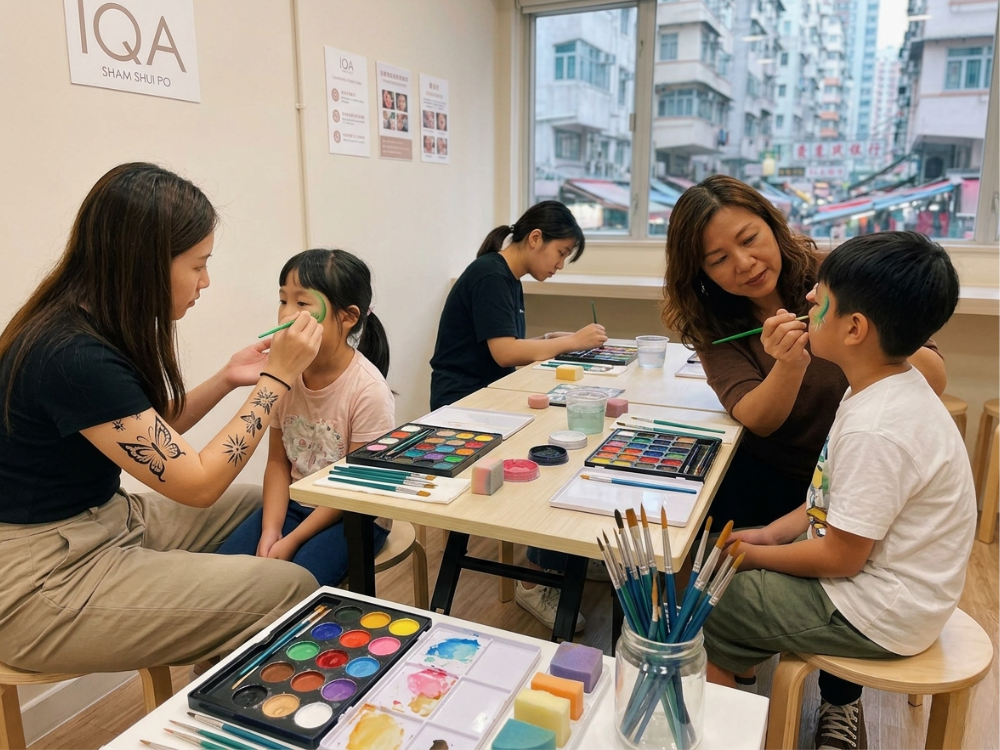
Students practicing face painting on models with instructor guidance, showing a small‑class environment.
11. Frequently Asked Questions
Q1: Are children prone to allergies from face painting?
A: We use only hypoallergenic water‑based pigments and strictly follow safety protocols. A patch test is always done before painting. Children aged 3 and above can enjoy it safely.
Q2: How long does face painting usually last? Can it be left overnight?
A: Under normal room temperature and minimal rubbing, face painting can last half a day to a full day. Although the pigments are gentle and harmless, we do not recommend leaving them on overnight. Remove gently the same evening with warm water and baby cleansing products.
Q3: I have zero art background. Is the IQA beginner course suitable for me?
A: Absolutely. IQA Level 1 is designed for complete beginners. It teaches tool recognition, brush grip, basic lines step by step – no prior art skills needed.
Q4: After obtaining an IQA painting certificate, what career opportunities exist?
A: In Hong Kong, painters with IQA international certification are highly sought after by event companies, shopping malls, and family organisations. You can work as an on‑site party painter, event painter, or start your own business freelancing, with flexible and stable income.
A: We use only hypoallergenic water‑based pigments and strictly follow safety protocols. A patch test is always done before painting. Children aged 3 and above can enjoy it safely.
Q2: How long does face painting usually last? Can it be left overnight?
A: Under normal room temperature and minimal rubbing, face painting can last half a day to a full day. Although the pigments are gentle and harmless, we do not recommend leaving them on overnight. Remove gently the same evening with warm water and baby cleansing products.
Q3: I have zero art background. Is the IQA beginner course suitable for me?
A: Absolutely. IQA Level 1 is designed for complete beginners. It teaches tool recognition, brush grip, basic lines step by step – no prior art skills needed.
Q4: After obtaining an IQA painting certificate, what career opportunities exist?
A: In Hong Kong, painters with IQA international certification are highly sought after by event companies, shopping malls, and family organisations. You can work as an on‑site party painter, event painter, or start your own business freelancing, with flexible and stable income.
Conclusion
Face and body painting has evolved from an ancient practical skill into a highly popular entertainment art and vocational skill in Hong Kong today. Relying on EU safety pigments, standardised operating procedures, and a professional teaching system, this technique not only enriches parties and events but also provides an accessible skill with broad career prospects. Whether you wish to book face painting services for a birthday party or children's event in Hong Kong, or want to learn the technique systematically from professional instructors in Sham Shui Po, take the progressive IQA Level 3 painting courses and obtain international qualifications, please use the contact methods above for more information. Seize this dual opportunity for both interest and career development.
Venue: Unit C-5, G/F, Winsun Building, 21-35 Castle Peak Road, Sham Shui Po, Kowloon
Enquiry / Registration WhatsApp: +852 9548 8600
Limited places – first come, first served.